
In the news
Pajaro Valley Community Leaders Rally at Watsonville Hospital for Yes on Measure E: Protecting Emergency Care in Santa Cruz County
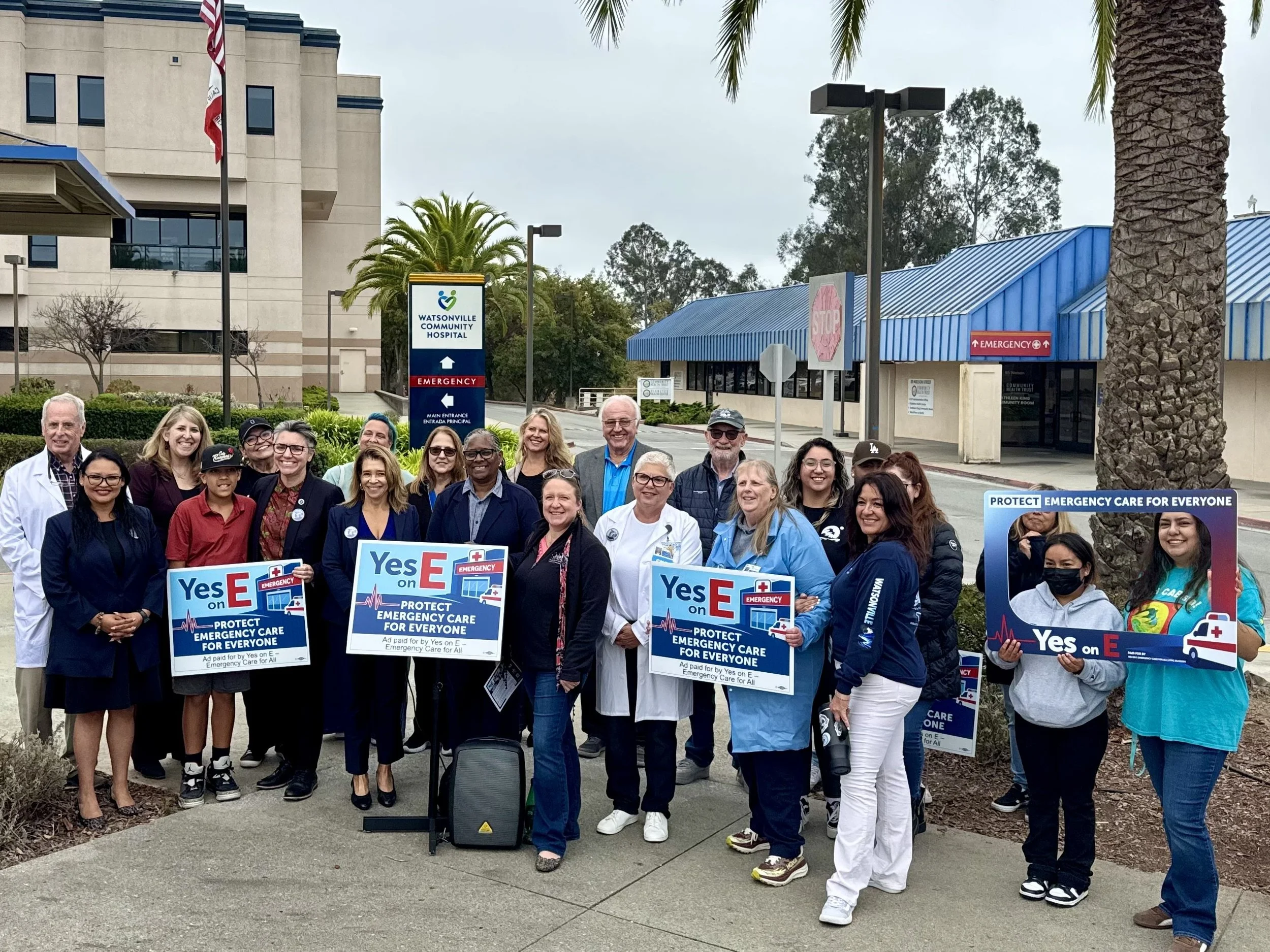
SANTA CRUZ, Calif. — Pajaro Valley leaders were joined today by community members to rally for Measure E, the ballot measure to protect emergency care for everyone in Santa Cruz County, at Watsonville Community Hospital. The hospital is among local healthcare services intended to benefit from voter approval of Measure E, a temporary half-cent sales tax that will help the County of Santa Cruz recover the more than $200 million in annual federal and related state funding losses affecting local healthcare and safety-net programs. Every dollar will stay in Santa Cruz County and be allocated through the County's public annual budget process.
Speakers at the event included: John Laird, California State Senator; Monica Martinez, Santa Cruz County Board of Supervisors Chair; Tony Nuñez, Pajaro Valley Health Care District Board Chair; Maria Orozco, Watsonville City Councilmember; Donna Young, Salud Para La Gente CEO; Maria Elena de la Garza, Community Action Board Executive Director; and Elaine Johnson.
Measure E is endorsed by dozens community leaders and local organizations, some of which include:
Pajaro Valley Health Care District
Watsonville Community Hospital Foundation
California Nurses Association
Community Bridges
Pajaro Valley Collaborative
Salud Para La Gente
Santa Cruz Community Health
Dientes Community Dental
Community Action Board
Santa Cruz County Fire Chiefs Association
Hospital Council of Northern and Central California
Santa Cruz County Democratic Party
Monterey Bay Central Labor Council
SEIU 521
For complete list of endorsements, visit www.yesonesantacruzcounty.com/endorsements
Measure E is a direct, local response to federal funding cuts that are an attack on Santa Cruz County’s public health services.
Measure E provides temporary (expires after five years), locally controlled emergency funding to: help keep local hospitals and emergency rooms open and protect 9-1-1 ambulance response; maintain community health clinics and access to urgent healthcare, reproductive care, mental health care and substance use treatment; support local food banks and food assistance; prevent homelessness and preserve housing stability; and protect seniors, veterans, people with disabilities, foster youth, children and working families.
Learn more about Measure E at www.yesonesantacruzcounty.com and on Facebook and Instagram.
###
Commentary: Measure E Needs and Deserves the Support of All Santa Cruzans
By Mark Dolson, from San Lorenzo Valley Post.
This month, Santa Cruz County voters are being asked to decide on 14 state propositions and two county measures. Few of us have time to carefully assess each of these, but we can still make our own informed decisions about a select few. In this spirit, I want to briefly explain why we should all care about and support Measure E.
Measure E is a specific, temporary county response to an equally specific, impending county financial crisis: an imminent shortfall of an estimated $200 million per year in the county’s essential services budget. This is the direct result of H.R.1, the so-called “Big Beautiful Bill” that reduced taxes for the wealthy and simultaneously reduced support for those in need. It directly eliminated $25 million of county funding per year, but the cumulative impact will be far greater due to hidden multiplier effects.
For example, county Medi-Cal enrollment is projected to decline 32% over 2025–2027. 25,000 people will lose coverage. A smaller number are facing reduced CalFresh nutritional assistance. All these people will be forced to rely on county-funded indigent care, public hospitals, and emergency services. This will lead to higher uncompensated care costs, longer wait times, and difficulties recruiting medical specialists.
These impacts often feel abstract and remote until we suddenly find ourselves unable to receive timely treatment at Dominican Hospital or waiting hours for an ambulance in the SLV. The reality is that insufficient voter support for Measure E will ultimately harm all of us. At a minimum, then, we should all understand exactly what we’re voting on.
The bottom line is that actions in Washington, D.C., have created a serious local problem. The county needs to respond, and it has only two options: (1) devise alternate ways of generating the required revenue, and/or (2) reduce spending on essential services via some combination of outright cuts and revised strategies.
The county is pursuing both options, and Measure E is one piece of this response. Measure E temporarily increases the sales tax throughout the county by 0.5% (i.e., 50 cents on $100). This should increase county revenue by about $27 million per year. This is only a fraction of what is needed, but this is because the county is engaging in a desperate triage exercise to deal with a crisis that has been foisted upon us.
My research for this op-ed has reassured me that our county supervisors have been extremely diligent and responsible in crafting their response. For example, California counties have been aggressively pushing for more state assistance, and the state has responded with helpful new legislation. Multiple cost-saving measures are also being pursued. In the end, though, the supervisors’ plan still hinges upon voter approval of Measure E.
Voters’ responses will depend on what question they ask. If the question is “Do I want to pay a higher sales tax?” the answer is obvious. Nobody welcomes higher taxes, and sales taxes are notorious for being regressive (i.e., they disproportionately impact the people who can least afford to pay). Measure E addresses this by exempting groceries, diapers, and prescriptions (and by opting for an almost negligible tax increment).
But voters may still wonder, “Isn’t there some better way of raising county funds?” In my own research, I have been unable to find any other revenue-generating solution that could realistically meet our needs. (This stuff is complicated, and it doesn’t help that our county keeps only 13% of the property tax revenue it generates!)
Another relevant question is, “What are other California counties doing?” Santa Clara County has adopted a similarly multifaceted approach, including a 0.625% sales tax increase approved by voters last November. Los Angeles voters approved a 0.5% increase this past June. Other counties will be watching us this November.
To me, though, the most important question is: “Do I want to live in a future where Measure E fails to pass?” Without this revenue, we are certain to see increased stress on our local health system, leading to worsening performance and, ultimately, to increased costs as preventive care is sacrificed. In addition, thousands of local residents will lose access to healthcare, food assistance, housing support, and other essential services. In short, our community will inevitably become a worse place to live.
Like many people, I initially questioned whether Measure E was the best solution. However, now that I have investigated in depth, I applaud our local governmental response. A YES vote for Measure E is an easy and essential way for us to preserve a system that our community depends on.
Mark Dolson leads the Indivisible Santa Cruz County Restore Democracy team, but he is writing here as a private citizen. More information about the Restore Democracy team is available online at restoredemocracyiscc.org.
Say yes to Measure E: A temporary commitment to protect the community we share
by Monica Martinez and Maria Orozco, from Lookout Santa Cruz
Imagine the moment you learn that your health insurance is gone. You still have diabetes. You still need your prescription. The appointment you waited months to get is still on your calendar. What changes is whether you can afford to go.
Now imagine that happening to thousands of our neighbors.
That is the challenge facing Santa Cruz County as H.R.1, the federal budget law enacted last year, reshapes healthcare, food assistance and other essential benefits. On Nov. 3, Measure E gives voters a choice: whether to participate in a temporary local response to federal changes that threaten our community.
We urge a yes vote.
About one-third of county residents rely on Medi-Cal. According to the Central California Alliance for Health, more than 30% of those could lose coverage in the coming years as federal and state changes take effect. Nearly one in six rely on CalFresh to feed themselves or their families, which is also under threat due to eligibility changes and increased administrative hurdles just to keep food on the table.
These are people we know: the worker preparing our food, the neighbor caring for an aging parent, the young adult managing depression while starting a career. Losing insurance can turn a manageable condition into a crisis. For a family already stretching every paycheck, one medical bill can threaten rent, groceries and stability.
The consequences reach people with private insurance, too. When patients lose coverage, hospitals and clinics lose reimbursement. More care goes unpaid. Providers face pressure to reduce services, and emergency rooms become the fallback for people using it for problems that should have been treated earlier.
Measure E would help protect access to emergency care for all of us, whether you rely on Medi-Cal, Medicare or private insurance. When someone you love needs an ambulance or an emergency room, what matters is that help is available when they need it.
Watsonville Community Hospital shows how fragile the system already is.
Hospital leaders recently warned that it could close within six to 12 months without action to improve its finances. It is already in the red by $86,000 per day. Service reductions in care for women, children and newborns are all on the table. Its difficulties have several causes, but further losses of insured patients would deepen the challenge.
For a family in the Pajaro Valley, this is about whether help is nearby when a baby needs specialized care or a loved one has a medical emergency. A hospital’s weakened finances can become everyone’s longer drive, longer wait and greater uncertainty.
Safety-net clinics and other community healthcare providers face similar pressures. When a trusted provider reduces services or closes its doors, cancer screenings, routine checkups, chronic disease management and other essential care become harder to access.
Thanks to members like you, Lookout is able to staff correspondents, editors and photographers to cover local races and issues across Santa Cruz County. Your membership is what allows Lookout to provide trusted information to the whole community in critical times like these. Thank you for your support.
Meanwhile, the backstop for people without insurance is under pressure. County budget reductions have made it difficult to provide indigent care for those without insurance, just as those numbers are expected to skyrocket. State changes will also end routine Medi-Cal dental coverage for certain adults without qualifying immigration status in July 2027, while retaining emergency care.
A painful tooth does not wait for a better budget year.
Food assistance faces federal changes as well. When help buying groceries shrinks, families still need to eat. Food banks, schools and community organizations inherit needs that Washington has chosen to stop meeting.
Measure E offers a limited bridge through these changes. It would add one-half cent to the countywide sales tax, generating an estimated $27 million annually for five years. That means 50 cents on a $100 taxable purchase. The tax expires after five years.
The revenue would support safety net services, with the board of supervisors identifying priorities including healthcare, emergency medical services, behavioral health, food security and housing stability. Voters should expect transparent spending decisions and clear results.
No local measure can replace every federal dollar lost. Nor does Measure E relieve county government of its responsibility to control costs, improve services and address its separate financial challenges.
What it can do is give our community resources and time to respond, strengthen partnerships and preserve essential help while longer-term solutions develop.
A temporary tax deserves serious consideration. So does the cost of allowing care to unravel: untreated illness, preventable emergencies, families losing stability and services that may be difficult to rebuild.
We all depend on the same hospitals, emergency rooms and network of local providers. When that network loses funding, the consequences can reach all of us. Protecting it means protecting the care any of our families could need, at any moment.
We cannot decide what Washington does. We can decide how we respond here, together. Measure E asks for a five-year commitment to our neighbors and the community we share.
That is why we need to vote yes.
Monica Martinez is the chair of the Santa Cruz County Board of Supervisors. Maria Orozco is a member of the Watsonville City Council. They are co-chairs of the “Yes on E – Emergency Care for All” campaign.
Editorial | Yes on SC County Measure E sales tax hike; Yes on Measure D, ocean and shoreline protection
View the full article from Santa Cruz Sentinel.
If it’s an election, there’s another tax hike on the ballot, right?
But sometimes raising taxes is the best option. Measure E is just such a choice. It asks voters to approve a 0.5% (half-cent) supplemental general sales tax increase for five years.
It was placed on the ballot by the Santa Cruz County Board of Supervisors to combat sweeping cuts in federal and state safety-net funding. The county projects an overall loss of $200 million.
The tax is estimated to generate $27 million annually. Santa Cruz County CEO Nicole Coburn told the Editorial Board this revenue will directly offset federal and state budget cuts to local healthcare, mental healthcare and food and housing security programs and help ensure local hospitals and emergency rooms stay open, along with safety-net clinics — vital as more than 30% of local residents on Medi-Cal insurance are due to lose coverage next year.
All the funds generated would stay under local county control rather than being diverted to the state or federal government. The tax is due to sunset in five years and needs 50% plus one vote to pass.
We take county officials at their word that the funds will be used for the specific purposes they’ve outlined.
At the same time we get that opponents wonder, where does this end? You can read local Republican Mike Lelieur’s op-ed published today urging a No vote on E, outlining how he feels the county’s track record doesn’t bode well for how funds raised through this increase will be used.
Because it is a general tax rather than a special tax, the revenue goes directly into the county’s general fund and opponents argue this means the money could technically be legally allocated toward any government expense — such as government worker salary hikes or pension obligations — rather than being strictly locked into healthcare and emergency services. Critics also argue that county leadership should first address internal government spending, non-competitive contract awards, and budget mismanagement before asking taxpayers to bail out budget shortfalls.
It’s also no secret that sales taxes are regressive, hitting lower-income residents the hardest on everyday purchases in a county where the cost of living is already extremely high.
All these arguments are worth considering — but so is this: county government is charged with ensuring the health and welfare safety net is there for those who need it the most. The Trump administration has made cuts that make this increasingly difficult.
A half-cent hike in the sales tax is a worthwhile means to keep services somewhat viable.
Yes on Measure E.
Yes on Measure D, coastal onshore development
Measure D also is a countywide vote on the Nov. 3 ballot. The measure asks voters whether the county should require a majority vote from the public before approving any land-use or zoning changes for onshore facilities that support deep-sea or seabed mining. It serves as an update to the county’s historic Measure A, passed by voters in 1986, which established similar voter-approval protections for onshore infrastructure supporting offshore oil and gas drilling. Save Our Shores then led the effort to pass 25 similar ordinances up and down the California coast, together known as the “Blue Wall,” which has held for nearly four decades.
Supporters — including local environmental groups, community activists and the county supervisors who referred it to the ballot — say Measure D will act as a necessary shield for the local coastline. They argue that the Trump Administration is aggressively expanding offshore oil leasing, undermining renewable energy, and opening federal waters to critical mineral mining, all framed as national security. California, and specifically the Central Coast, is a primary target.
Measure D modernizes and legally strengthens the 1986 county ordinance so it holds up under current state and federal law. It also closes a gap by extending protection to deep-sea mining, which the original language never anticipated. Local onshore ordinances are the one lever Santa Cruz voters control directly, since offshore development requires onshore infrastructure to function.
There is no organized local opposition to Measure D.
Vote Yes on Measure D, which is all about who gets to decide what happens on Santa Cruz’s coast.
Campaign Kicks off for Yes on Measure E: Protecting Emergency Care in Santa Cruz County
Community and healthcare leaders advocate for November ballot measure, endorsed by Santa Cruz Community Health, Sutter Health, Watsonville Community Hospital Foundation, Community Action Board, Community Bridges, California Nurses Association, Santa Cruz County Fire Chiefs Association and many more
SANTA CRUZ, Calif. — Measure E, the ballot measure to protect emergency care for everyone in Santa Cruz County, held a kickoff event at Live Oak Health Center, home of Dientes and Santa Cruz Community Health, on Thursday, Sept. 17. Speakers highlighted the critical need to Vote Yes on Measure E on November 3.
Speakers at the kickoff event included: Monica Martinez, Santa Cruz County Supervisor; Maria Elena de laGarza, Community Action Board CEO; Dr. Donaldo Hernandez, Sutter Health; Laura Marcus, Dientes CEO; and Adam Spickler, Cabrillo College Trustee.
Measure E is a direct, local response to federal funding cuts that are an attack on Santa Cruz County’s public health services. Measure E provides temporary (expires after five years), locally controlled emergency funding to:
Keep local hospitals and emergency rooms open and protect 9-1-1 ambulance response;
Maintain community health clinics and access to urgent healthcare, reproductive care, mentalhealth care and substance use treatment;
Support local food banks and food assistance;
Prevent homelessness and preserve housing stability; and
Protect seniors, veterans, people with disabilities, foster youth, children and working families.
Organizations supporting Measure E: Santa Cruz Community Health, Sutter Health, Watsonville Community Hospital Foundation, Community Action Board, Community Bridges, California Nurses Association, Santa Cruz County Fire Chiefs Association, Santa Cruz County Democratic Party, Democratic Club of North Santa Cruz County, Democratic Women’s Club of Santa Cruz County, Monterey Bay Central Labor Council, SEIU Local 521, Pajaro Valley Collaborative, NAACP Santa Cruz County, Santa Cruz County Middle Management Association, Santa Cruz for Bernie, and Sheet Metal Workers Local 104.
Measure E is a half-cent sales tax that will generate approximately $27 million annually for five years, helping to replace the more than $200 million in annual federal and related state funding losses affecting local healthcare and safety-net programs. Every dollar will stay in Santa Cruz County and be allocated through theCounty's public annual budget process.
Learn more at yesonesantacruzcounty.com and follow on Facebook and Instagram.
###